


Unapproved parts: how digital traceability protects your workshop
10 Novembre 2026
Since the 2023 falsified-certificate scandal, authorities and customers look very closely at the stores of Part-145 workshops. The answer is not one more check: it is an unbroken chain of evidence, from purchase order to installation, that only digital tracking makes reliable.
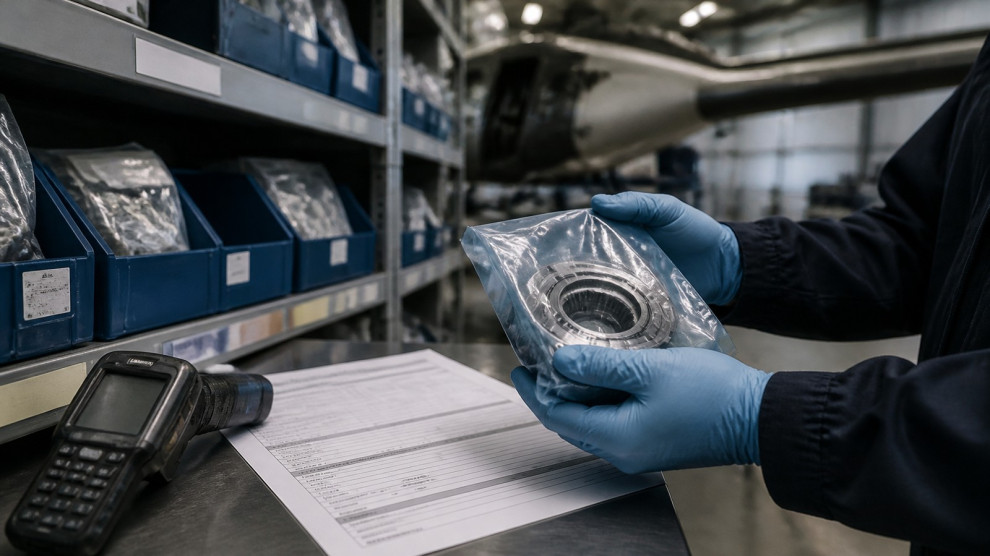
Why the subject has become a priority
In 2023 the industry discovered that a distributor had, for years, sold engine parts accompanied by falsified release certificates. Thousands of parts had to be traced, removed and replaced on aircraft in service. EASA, the FAA and national authorities have since multiplied their bulletins on Suspected Unapproved Parts (SUP), and Part-145 audits now devote real time to the stores.
The question put to the workshop is simple: for every part installed, can you prove where it came from? Not just produce a certificate, but demonstrate that the certificate matches that part, and that it was received, inspected, stored and installed by identified people, with no break in the chain.
What an unbroken chain of evidence looks like
A conforming aircraft part leaves a trace at every step. If one trace is missing, the part becomes suspect:
- Ordering: evaluated and listed supplier, manufacturer part number, quantity, certificate requirement stated.
- Receipt: check of the release certificate (EASA Form 1, FAA 8130-3, TCCA Form One or certificate of conformity as applicable), match of part number and serial or batch number, packaging condition, remaining shelf life for perishable items.
- Storage: location, conditions, label, strict segregation of serviceable, repairable, quarantined and scrapped parts.
- Issue and installation: work order, aircraft, position, hours and cycles at installation, technician, release-to-service signature.
- Removal and return: reason, destination (repair, scrap, return to supplier), status tag.
On paper or spreadsheets, each of these steps can be forgotten, backdated or copied with an error. That is exactly what forgers exploit.
What digital tracking makes impossible to bypass
Workshop management software designed for aviation does not merely record: it prevents. With TracingLine, for instance:
- a part cannot enter stock without its scanned certificate attached to its record;
- the serial number is entered once, at receipt, then followed by barcode scanning until installation — no more retyping;
- a quarantined part is locked: it does not appear among the options available on a work order;
- every movement is time-stamped and signed; the history cannot be edited, only added to;
- the full history of a serial number — order, certificate, successive installations and removals — is displayed in one search, ready for the auditor or for a manufacturer alert.
Tooling traceability follows the same logic: through our partnership with Nexess, calibrated tools are identified and linked to the jobs on which they were used.
Three habits to adopt this week
1. Audit a serial number at random. Pick a part installed last month and time how long it takes to gather its certificate, its goods-receipt note and its work order. Beyond ten minutes, your chain has a weak link.
2. Check your suppliers. Every parts distributor must appear on an evaluated, periodically reviewed list; a perfect certificate from an unknown supplier is still a warning sign.
3. Make the certificate mandatory in the tool. As long as a stock entry can be saved without an attachment, the control relies on one person's vigilance, not on a process.
Want to see parts receipt with a mandatory certificate and serial-number tracking? Book a TracingLine demonstration: 30 minutes online, on your own cases.
-

-

Your CAMO audit (national authority / EASA): the checklist to walk in ...
-

The 100% digital airworthiness record: compliance, electronic ...
-

Part-IS: cybersecurity is no longer optional, it is a regulatory ...
-
Why Airbus and Safran certify our data processes with TracingFlight
-
From calendar-based to predictive maintenance: what data changes ...
-

Performance · Availability
-

Buying guide · CAMO
-

Airworthiness · Regulation
-

Tracing Flight & Nexess