


The 100% digital airworthiness record: compliance, electronic signature and audit trail
14 Octobre 2026
Moving to digital airworthiness records: e-reporting, electronic signature, audit trail and data continuity. What an auditable record requires for your private aircraft, business jets, ATRs, helicopters and drones.
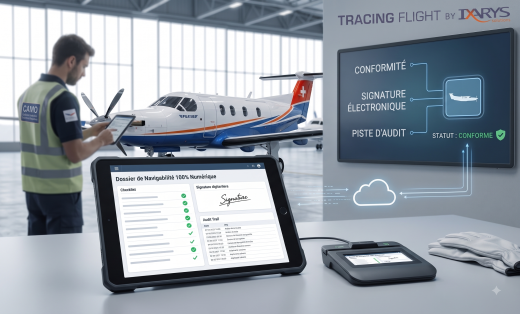
The 100% digital airworthiness record
The end of the binder: e-records, electronic signature and audit trail. How a well-kept digital record makes your airworthiness reviews reliable and saves you a considerable amount of time.
The airworthiness record is the aircraft's memory. Every task, every part, every decision leaves a trace in it. As long as that memory lives in binders and scattered PDFs, it is fragile: you search, you photocopy, you re-key, you hope the right version is the latest one. Going digital is not about scanning paper: it is about turning this record into a single, reliable and auditable source.
What "electronic" really means
A compliant digital record is not a record "on a computer". It rests on three pillars:
- Integrity. Data once entered cannot be quietly altered: every change is dated, attributed and kept.
- Electronic signature. The maintenance release, the review, the certificate are signed digitally with the same binding value as a handwritten signature, and far better traceability.
- Audit trail. Who did what, when, on which version: the history can be reconstructed at any time, effortlessly.
It is this combination that turns simple archiving into an enforceable record.
Why now is the right time
The regulatory side is already moving: EASA supports the dematerialisation of airworthiness data, and recent 2026 developments simplify the digital handling of documents when aircraft are transferred between Member States (recommendations, ARC). The direction is clear: less paper, more digital continuity. Better to get on board now, in good conditions, than in the rush of an inspection.
The concrete gain: a stress-free airworthiness review
It is at review time (ARC) that the digital record shows its value. Instead of piecing together a history from scattered sources, you unroll a complete, consistent, time-stamped record. On a varied fleet – private aviation, business jets, ATRs, civil or military helicopters, drones – this rigour is even more valuable: each aircraft has its own continuous thread, available in seconds, including to your operator or owner partners through secure read-only access.
The benefits add up:
- Zero re-keying between the workshop, airworthiness and the archive.
- No more multiple versions: a single, up-to-date truth.
- Controlled, traceable access, including offline for the workshop.
- Instant search instead of document archaeology.
Digital does not mean fragile – quite the opposite
The legitimate fear is "what if I lose everything?". Well designed, a digital record is more robust than paper: tested backups, controlled hosting (cloud or on premise), controlled access rights, logging. Where a binder burns or goes missing, a well-kept digital record can be restored. It is also a direct building block of your information security (see Part-IS).
The digital airworthiness record is not a convenience: it is the most reliable way to keep the memory of your aircraft.
-

-
Why Airbus and Safran certify our data processes with TracingFlight
-
From calendar-based to predictive maintenance: what data changes ...
-

Performance · Availability
-

Buying guide · CAMO
-

Airworthiness · Regulation
-

Tracing Flight & Nexess
-

Tracing Flight at the 2025 Paris Air Show: meet us on the Région Sud & ...
-

Tracing Flight by Ixarys
-

Strategic partnership