


From calendar-based to predictive maintenance: what data changes for your availability
28 Août 2026
Moving from "on due date" to "on actual condition": how reliability data and the right indicators improve the availability of a fleet of private aircraft, jets, ATRs, helicopters and drones.
From calendar-based to predictive maintenance
Moving from "on due date" to "on actual condition": what reliability data concretely changes for the availability of your fleet.
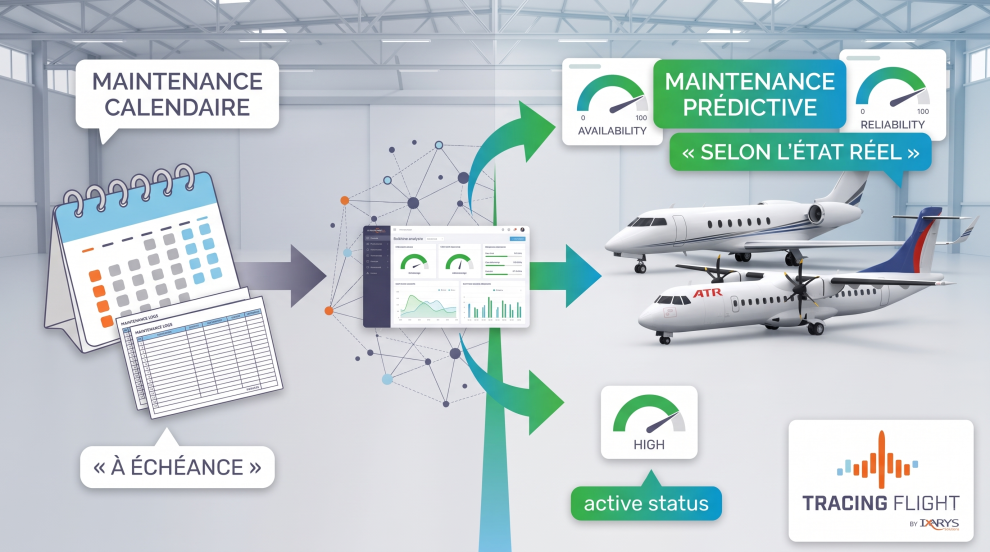
For a long time, maintenance followed the calendar and the counter: so many flight hours, so many cycles, so many months. A safe, proven logic – but one that has a price. Sometimes an aircraft in perfect condition is grounded because "the due date has come", and conversely a drift that is not yet visible in the calendar can be missed.
Predictive maintenance is not about throwing away the calendar: it is about complementing it with observation of the actual condition, aircraft by aircraft. And that rests on one single thing: clean data, collected and exploited.
The starting point: a living reliability programme
A reliability programme (reliability monitoring) is not a binder you pull out for the audit. It is continuous monitoring that aggregates events – failures, deferrals, troubleshooting, replacements – and brings out trends before they turn into groundings.
On a heterogeneous fleet – business jets, ATRs, civil or military helicopters, drones – each aircraft type has its own signatures. Reliability monitoring lets you compare like with like and spot the anomaly that stands out: a component failing twice as often as the average for its series, a lengthening supply lead time, a task that systematically generates deferrals.
The indicators that really matter
Everything comes down to a few indicators, provided they are fed automatically and not re-keyed:
- Operational availability of each aircraft and of the fleet – the ultimate judge.
- The task deferral rate (and its evolution) – a weak signal of strain.
- MTBF / MTBUR per component – to distinguish normal wear from drift.
- Average downtime and the causes of AOG (aircraft on ground).
- Workshop load against resources – to anticipate bottlenecks.
A good CAMO tool does not just store these figures: it surfaces them in dashboards and alerts, so that a drift triggers a decision, not a late discovery.
What it changes day to day
Switching to predictive produces three very concrete effects:
- Fewer unplanned groundings. The intervention is scheduled when the condition (and the diary) allow it, not in an emergency.
- A more available fleet. In activities where the aircraft has to fly – medevac, offshore, surveillance, missions – every point of availability gained has a direct value.
- Evidence-based trade-offs. Extend, replace, renegotiate a supplier lead time: decisions rest on trends, not impressions.
The tool does not decide for you: it arms you
Predictive maintenance is not a black box that "predicts the future". It is a discipline: capture the data at source, make it reliable, put it in front of the right people at the right time. The software (on the CAMO side, TracingNav) does the thankless work of collecting and trending; the decision remains that of your airworthiness experts.
That is where availability is won: not by working more, but by seeing earlier.
Want to see your own availability indicators come to life?
-
-

Part-IS: cybersecurity is no longer optional, it is a regulatory ...
-
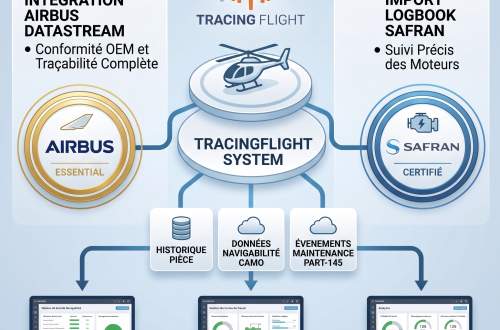
Why Airbus and Safran certify our data processes with TracingFlight
-

Performance · Availability
-

Buying guide · CAMO
-

Airworthiness · Regulation
-

Tracing Flight & Nexess
-

Tracing Flight at the 2025 Paris Air Show: meet us on the Région Sud & ...
-

Tracing Flight by Ixarys
-

Strategic partnership