


Skills shortage in the French aerospace industry
28 Mars 2024
How to reverse the trend?

(5-minute read)
With the Covid crisis behind it, the French aerospace industry has bounced back and has enjoyed a strong recovery for two good years. Just look at the manufacturers' order books: they are full! But the industry is not doing so well for all that. Like many sectors in France, it struggles to find qualified talent. If companies do not quickly find solutions to reverse the trend, their competitiveness could suffer, with a slowdown in growth as a consequence.
Solutions do exist, though. Before sharing them with you, let's analyse the reasons for this labour shortage.
According to the French Aerospace Industries Association (GIFAS), the sector plans to recruit in 2024: 50,000 positions in production; 30,000 in engineering; 20,000 in maintenance; 10,000 in sales and marketing; and 5,000 in administration.
Multiple factors
1. A favourable climate for air transport
- Demand for air transport is rising sharply, boosted by the Covid effect; it should reach 100% of its pre-crisis level in 2024;
- Decarbonisation requires significant development of new products and technologies, particularly in electric flight and sustainability;
- This momentum benefits maintenance and repair activities, which are directly affected;
- Demand for people with sharp technical skills, particularly in engineering, maintenance, production and AI, has grown in recent years, creating strong tension on these profiles.
2. The age pyramid
- Demographics do not favour the industry, with older workers retiring. Replacing this skilled workforce is a significant recruitment challenge, exacerbated by the widening skills gap.
3. A disrupted supply chain and pressure on operating costs
- Raw material shortages and price instability, combined with shipping delays, affect the industry as a whole, including the recruitment of new employees and talent retention;
- Rising and volatile fuel prices strongly affect the aviation sector. To contain costs, companies are forced to make choices and allocate fewer resources to other areas, notably recruitment and overall growth.
4. A mismatch between needs and training
- Although the aerospace sector needs new talent, the training available is not always suited to the needs of its companies.
5. A lack of attractiveness of the aerospace industry
- Perceived as a difficult and demanding sector, candidates turn to other sectors such as tech (IT and digital), more attractive to young graduates who are reluctant to do manual work.
- SMEs and mid-caps, notably because of a less developed employer brand, compete with companies that deploy a whole arsenal to attract talent.
Combined, these factors create a complex environment for aerospace SMEs, making it difficult to recruit and retain the qualified talent essential to growth and competitiveness in this sector.
SMEs and small businesses: solutions and 4 areas to work on
- Diversify recruitment sources: companies must open up to new profiles, in particular people retraining or employees from other sectors, as well as profiles without initial or continuing training.
- Provide suitable training for recruits, in line with the company's needs. Offer more tech-oriented tools, which make it possible to move fast and are more in tune with the agility of the digital generation.
- Strengthen the company's attractiveness and upgrade manual trades: offer attractive working conditions such as interesting career prospects, benefits and competitive salaries.
- Give meaning: companies must highlight the interest of the tasks entrusted, particularly when they concern flight safety, and the innovative nature of the approach and tools made available to teams.
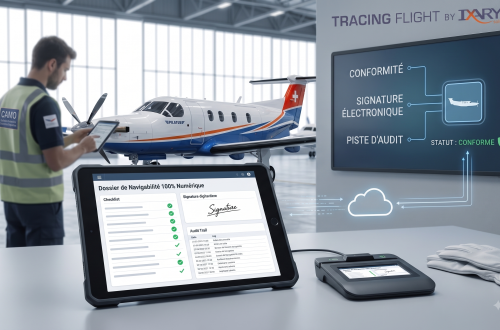
Tracing Flight, the new-generation aircraft maintenance software suite for CAMO and MRO activities, is the essential tool for all types of aircraft of different sizes and complexity. It will bring your teams on board, make their work easier and save them time. Agile, ergonomic and designed to be user-friendly, it meets in every respect the usage preferences of the younger generations. Designed by technicians, aeronautical engineers and digital specialists, it meets the requirements of traceability, regulatory compliance, optimisation, cost control and operational efficiency.
Our team, involved in the field, offers to support and train technicians and employees in the use of airworthiness management software. Qualiopi-certified, our training courses fit into your training budgets.
▶️ For a demo, contact us: www.tracingflight.com/contact.php
-
-
Part-IS: cybersecurity is no longer optional, it is a regulatory ...
-
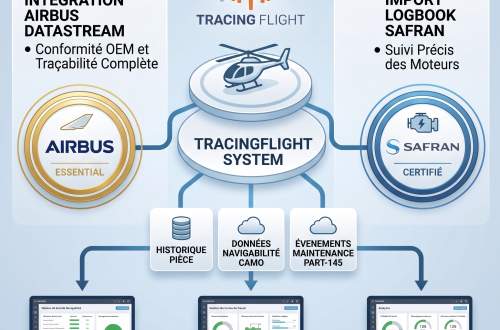
Why Airbus and Safran certify our data processes with TracingFlight
-
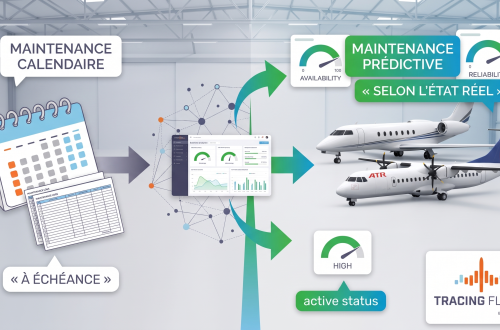
From calendar-based to predictive maintenance: what data changes ...
-
Performance · Availability
-
Buying guide · CAMO
-
Airworthiness · Regulation
-

Tracing Flight & Nexess
-
Tracing Flight at the 2025 Paris Air Show: meet us on the Région Sud & ...
-
Tracing Flight by Ixarys